
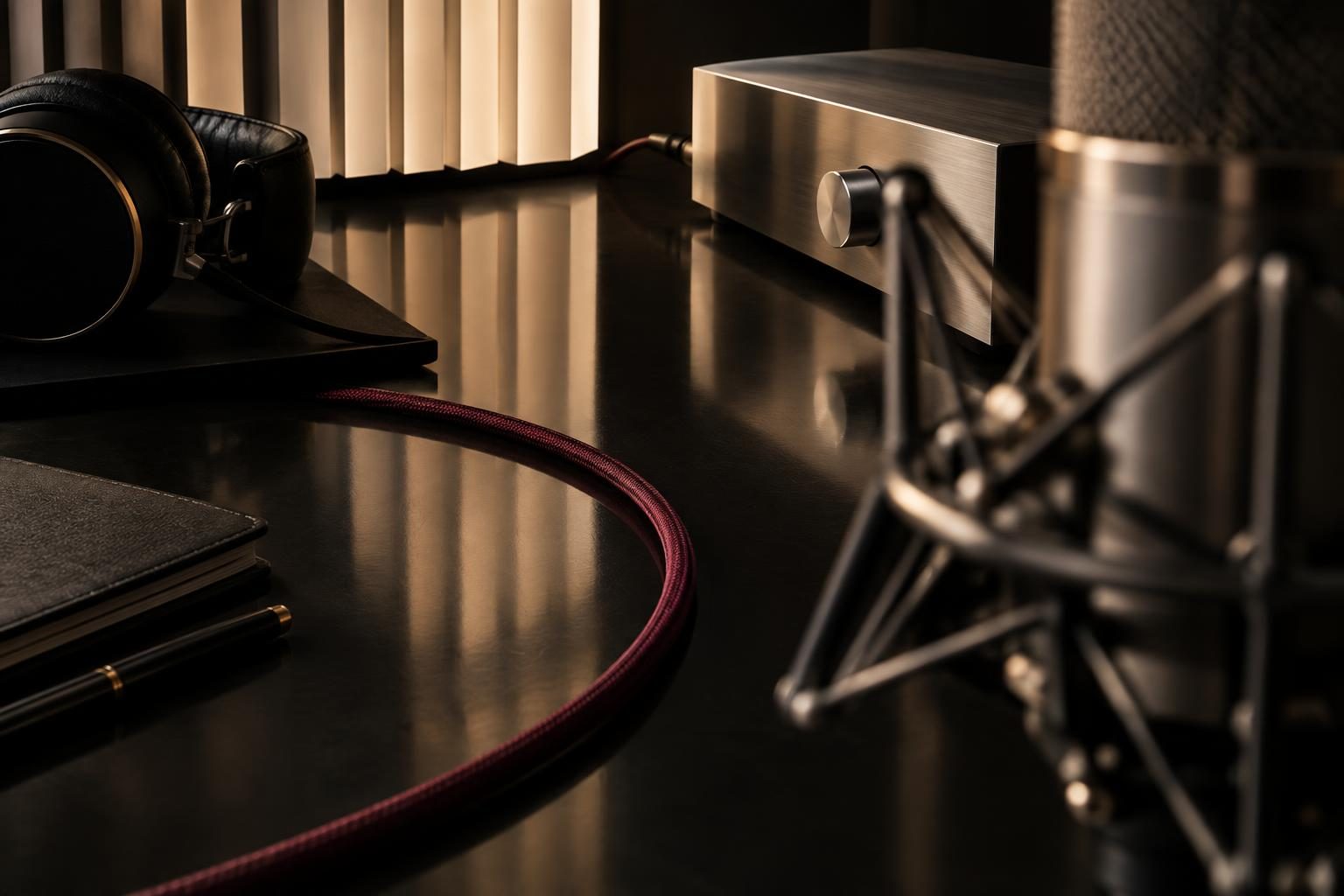
A B2B launch built around creative confidence
On 6 October 2026, Music Instrument News covered Neumann’s Hear the Moment campaign. Neumann’s own newsroom announcement, published in late September, presents it as the German audio company’s first global brand campaign.
The story is not simply that another brand film has gone live. The useful production point is that Neumann is building a global communications platform around a technical promise: reference quality across the signal chain, from capture to playback.
According to Neumann, the campaign launches first across Germany, the United Kingdom and the United States, with digital channels, social media, trade media, online advertising and selected out-of-home placements. Further Asia-Pacific activity is planned for the following year.
For a music and sound agency, the interesting question is not whether we can fully review every media execution. We cannot, and we should not imply otherwise. The useful question is how a B2B audio brand turns technical credibility into a story that creators and producers can feel.
Hear the Moment’s answer is clear: do not make the product the whole story. Make the creative decision the story. The campaign frames Neumann around the instant when an idea becomes a take, a performance, a mix choice or a final playback.
Turning a specification into a human story
The common trap in B2B audio is specification overload. Frequency response, converters, dynamic range, monitoring, headphones, microphones and software all matter, but a list of capabilities rarely creates a memorable brand platform by itself.
Neumann’s campaign moves the emphasis toward trust in the creative process.
The Hear the Moment landing page describes a journey from first inspiration to final playback and positions Neumann’s full signal chain as a reference-quality environment that helps creators work with confidence. The official campaign materials connect that idea to microphones, audio interfaces, studio monitors, headphones and software.
That shift is commercially useful. Professionals are not only buying equipment. They are buying less doubt at critical moments. Is the recording telling the truth? Is the monitoring reliable? Will the decision still stand after client review, mastering, delivery, streaming, live playback or headphone listening?
That question matters to engineers, producers and artists. It also matters to brands commissioning films and campaigns. In production, value often comes from better decisions made earlier, not from more options added later.
This is where music and sound strategy become part of the same conversation. A brand that sells accuracy should not sound vague. A brand that sells confidence should not mix its film as if every layer is fighting for proof.
A useful model for technical brands
Consider a camera, lens or post-production software company planning a manifesto film.
One route is familiar: hero shots of the product, spectacular edits, large music, premium grade. It may impress in a trade-show environment, but the idea often remains interchangeable. Another brand could replace the logo without changing much of the film.
A stronger route is to isolate a decision moment: the cinematographer choosing exposure, the editor cutting a breath, the sound designer removing an effect, the director allowing silence to stay. The campaign no longer sells a feature list. It sells the calm needed to make a better professional decision.
That is the broader lesson from Hear the Moment. Sound should not be treated as a finishing layer for a technical film. It can carry the proof of the promise: precision, control, sensitivity and trust.
For producers, that means the audio brief should ask more than “what mood should the music create?” It should ask “what decision does the sound make believable?” If the answer is reference quality, the composition, sound design and mix all need to behave with restraint. If the answer is speed, the sound architecture may need sharper transients and tighter edit integration.
For more on dividing those responsibilities, see music and sound design in post-production.
The serious limitation: emotion can become generic
There is a real risk in this kind of positioning. “Creative moments” are attractive language, but they can become soft if they are not tied to proof.
Neumann’s campaign has an advantage because it can connect the emotional story to a tangible chain: capture, production, monitoring and playback. The official landing page keeps the product ecosystem visible, rather than leaving the film in pure inspiration.
Still, the production lesson is cautious. Emotion should open the door, not replace evidence. A technical brand film can be sensitive and still show what the product changes in the user’s work.
In a brief, that means defining the user transformation first, then choosing the sonic and visual cues that prove it. Without that step, the result may look polished but generic.
This is particularly important in premium technology, culture, fashion and luxury-adjacent production. Music that is too large can blur the benefit. Sound design that is too demonstrative can turn precision into gimmick. A dense mix can contradict a promise of reference listening.
The restraint is not aesthetic minimalism for its own sake. It is credibility. If a film claims that a brand helps professionals hear clearly, the film itself has to leave space for clarity.
What producers can take from it
Hear the Moment offers three practical takeaways.
First, a technical subject can be emotional if the emotion is linked to a professional decision. In this case, the decision is reliable listening.
Second, the signal chain can become the narrative. Capture, production, monitoring and playback are not just product categories. In the right film structure, they are dramatic stages.
Third, Neumann’s stated choice not to use generative AI for the film’s visual worlds is a positioning signal. It should not be overclaimed as proof of craft quality. But it does align the message about human creativity with a production method the brand wants to foreground.
For agencies and brands developing B2B films, the practical conclusion is simple: do not brief only for “inspiring music.” Brief the belief the sound must create.
That belief may be trust, speed, precision, intimacy, scale or control. Once it is named, the composer, sound designer and mixer can make decisions that support the same argument.
Sul Tasto can help when a campaign needs original music, sound design, edit sensitivity and reliable deliverables to work as one system. Related reading: when to bring in a music agency and how to brief a composer for an advertising film.