
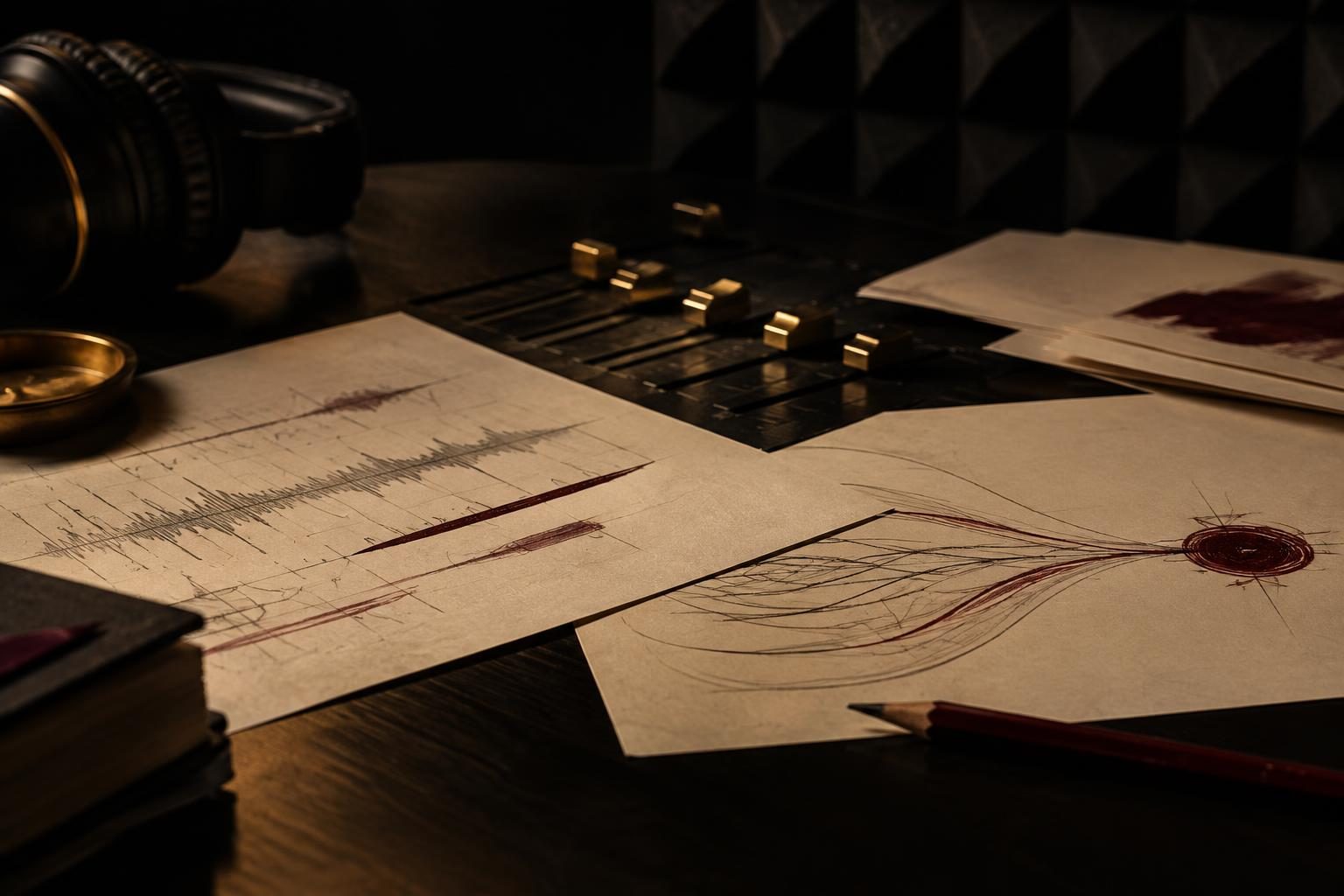
The decision is not territory, it is function
In commercial production, the question “is this music or sound design?” often arrives when the edit is nearly locked. The director has lived with a temp track. The client has approved a mood. The voiceover has moved. The mix suddenly feels crowded.
At that point, the discussion can sound territorial. It should not be.
Music, sound design and mix have different jobs. Music shapes emotional trajectory, memory, momentum and sometimes brand identity. Sound design shapes matter, gesture, movement, transitions, credibility and physical sensation. The mix decides what the viewer must understand, feel and remember at any given second.
A film may need a strong original score with very restrained sound design. Another may need almost no music, but a precise sound world built from air, texture, impact and silence. The problem begins when every layer tries to do the same job.
For an agency producer or film producer, the commercial issue is simple: avoid paying twice for the same intention, then losing time removing work that should never have competed in the first place.
At Sul Tasto, we try to settle this early. Not to limit the creative process, but to place the sonic energy. That is especially useful in luxury, beauty, sport, technology and film-led brand work, where the line between musical gesture, designed texture and mix movement is deliberately thin.
Related reading: original music for advertising, silence in advertising and when to bring in a music agency.
What the music should carry
Music carries a line through time. It can give an edit continuity, set tension, create anticipation, elevate a product reveal or give a brand a recurring musical asset.
In a thirty-second commercial, music rarely has the space to develop like it would in a film scene. It often has to arrive with meaning already built in. Tempo, instrumentation, harmonic density, motif placement and dynamic range become editorial decisions.
Music can also solve structure. A fragmented montage may need a pulse, drone, string figure or hybrid texture to bind the cuts. A flat edit may need the opposite: a score that withholds resolution rather than underlining every picture change.
But music should not do everything.
If it comments on every gesture, fills every silence, marks every transition and fights the voiceover, it stops being useful. It can make the film feel less confident. In premium work, over-explaining is often the fastest way to reduce value.
So the useful question for a composer is not only “what emotion are we after?” It is also “what should the music leave available for other layers?”
That matters even more on campaigns with many deliverables. A hero film might sustain an orchestral or hybrid arc. A six-second cut may need a single recognisable gesture, a clean attack and a controlled ending. If those needs are considered only after approval, versioning becomes repair work.
What sound design should decide
Sound design is not a bag of effects. It is the authored sound world of the film.
It can make a gesture believable, enlarge a material, stylise movement, connect two images that were never shot together or give a product physical weight. It can also reveal what the camera does not show: scale, pressure, fragility, speed, intimacy, distance.
In contemporary advertising, sound design often works close to music. A filtered breath, a low hit, a granular rise or a metallic impulse may function rhythmically. It does not need to be written as a score to shape the listener’s experience.
This is where ownership has to be clear.
If the composer is writing hybrid music with hits, pulses, risers and noisy textures, decide whether those elements live in the music stems or in the sound design session. If the sound designer creates tonal drones or repeated motifs, decide whether those elements have become musical assets, with the rights and approvals that may follow.
Awards bodies reflect this overlap. D&AD frames Sound Design & Use of Music around the application of sound and music composition to commercial, design, gaming and advertising projects. That is close to production reality: the crafts overlap, but the deliverables still need to be legible.
A producer does not need to police taste. They need to know what exists, who made it, where it sits, and how it can be used when the campaign becomes a dozen cutdowns.
The mix should not be a rescue session
The final mix should not be the first moment anyone discovers that the music masks the line, the impacts flatten the dynamics or the social version collapses on a phone speaker.
The mix is both creative and technical. It decides hierarchy. In a commercial, that hierarchy may change every two seconds: voice, product sound, logo, breath, silence, music, impact, legal line.
Loudness standards make that hierarchy more than a matter of taste. In Europe, EBU R 128 recommends average programme loudness around minus 23 LUFS, with Loudness Range and True Peak descriptors. In the United States, television practice is tied to ATSC A/85, while the CALM Act and FCC rules address the problem of television commercials being transmitted too loudly against surrounding programming.
Those documents do not replace broadcaster, platform or media-owner specifications. They do explain why a commercial mix cannot be judged only in a comfortable studio. It must pass checks, survive encoding, remain intelligible on mobile and avoid creating a volume shock in a media environment.
Ask early: is there a broadcast master? A cinema master? Social-only cutdowns? DOOH? Retail? Event playback? Radio? A proprietary platform? The same sound design move will not translate equally across all of them.
A practical example: a fifteen-second beauty film
Imagine a fifteen-second beauty film. Close skin details, a hand movement, cream texture, packshot, short voiceover, three deliverables: 16:9, 9:16 and six seconds.
A weak division of labour would be to commission elegant music, then later add whooshes, sparkles, air, impacts, product sweeteners and a sonic logo. The result may feel expensive in isolation and confused in the film. Everything shines. Nothing breathes.
A stronger approach starts with function.
The music holds restraint: suspended harmony, processed strings, a soft low foundation, minimal development. It does not chase every cut. It gives the brand a calm frame.
The sound design owns material: close skin friction, a tiny intake as the jar opens, a tactile transition between texture and packshot. The effects are selected, short and never demonstrative.
The mix protects the voice for two lines, then lets the music open on the packshot. The six-second cut keeps only the most identifiable musical gesture and two product sounds. The 9:16 version trims low-end energy so it translates better on mobile.
This is not a more complicated process. It is a process with earlier decisions.
The real limitation: hybrid work can blur rights
The serious objection is fair. Many modern films are made by hybrid teams. The same composer may design impacts. The same sound designer may build tonal beds. A single session may contain music, effects, processing and mix automation.
Why separate them?
Because the separation is not always artistic. It is contractual, operational and editorial.
If a sound texture becomes a recurring brand asset, the production must know who created it, under what agreement, for which media, in which territories and for how long. If an impact comes from a commercial sound library, the licence matters. If a tonal element is based on a third-party sample, it may raise different questions from a bespoke recording.
The answer is not to make the work safer or smaller. The answer is to document sources, name stems clearly and approve usage properly.
That connects directly to broader campaign questions: rights, territories, deliverables and version control. For more on that side of the production, see music rights for a multi-territory campaign and original score versus production music.
What to put in the brief
Before sound post begins, add one decision page to the brief.
Define the music function: emotional role, level of presence, trajectory, relation to voice, memorisable elements and expected cutdown behaviour.
Define the sound design function: realism, stylisation, transitions, product detail, rhythm, silence and any sounds that should become ownable campaign assets.
Define the mix and delivery reality: formats, durations, media, loudness targets, stems, no-voice versions, no-music versions, M&E if required, and who signs off each master.
Finally, define priority rules. For example: voice always wins over music; product detail wins over transitions; the sonic logo must never be masked; the silence before the packshot must remain.
That one page prevents many subjective arguments. It lets the composer, sound designer, editor, mixer, producer and client work inside the same film.
When a campaign needs original music, crafted sound design and reliable versioning, the job is not simply to “find a track.” It is to design the listening architecture. Sul Tasto can help at that level, from brief to final mix, without reducing the creative ambition.