
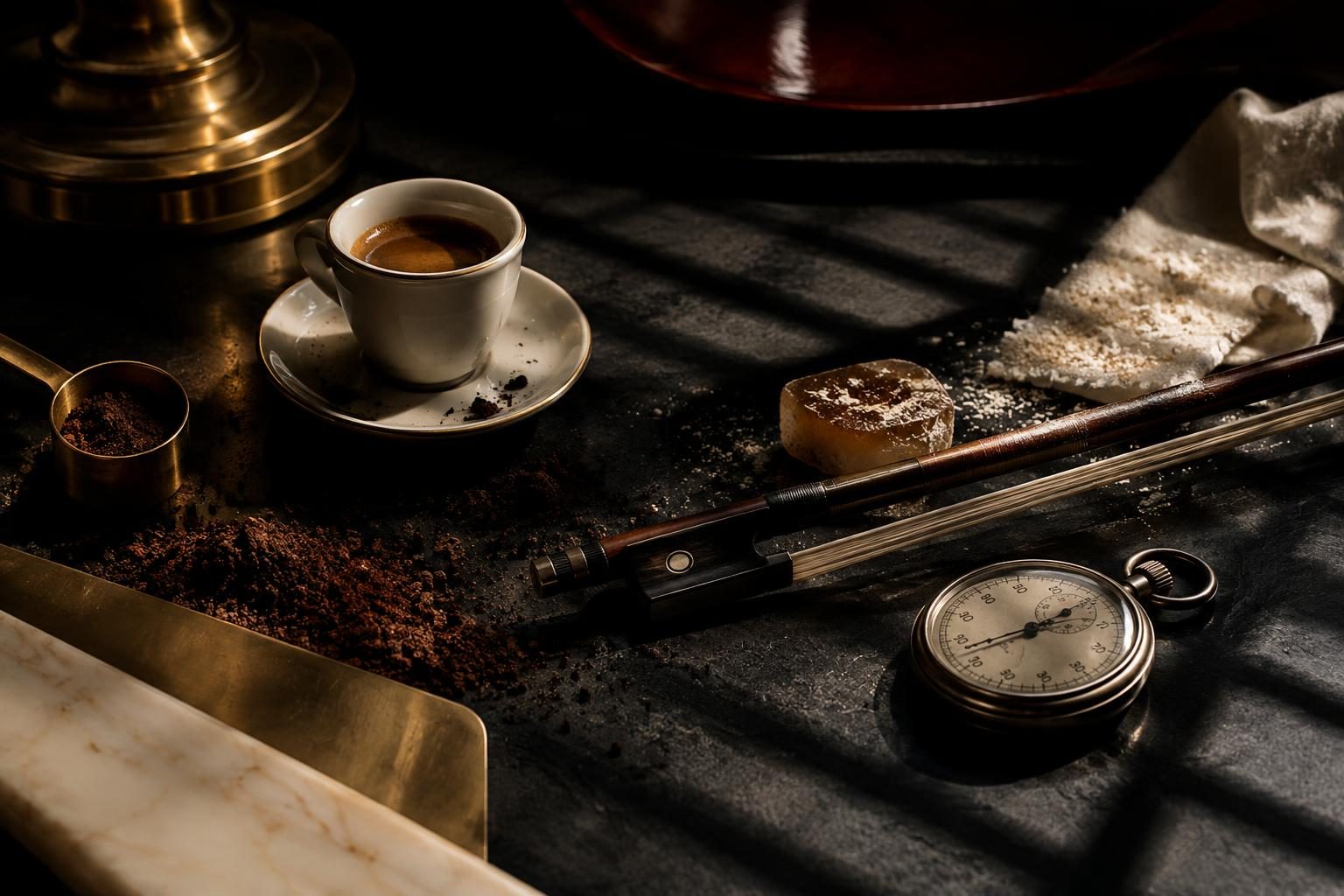
Breville has launched “Because Great Coffee Matters,” a global campaign from Australian independent agency Emotive. Its launch film, “Glorious Coffee,” is built around a clear sound idea: a twenty-five piece ensemble performs as a morning coffee is made.
According to Emotive’s own campaign post and trade coverage, the original score was composed by Rumble Studios and performed live on set by an ensemble from Sydney’s Metropolitan Orchestra. The film was directed by Kyra Bartley through COUSIN. Campaign Brief credits Felix Bornholdt and Nick Polovineo as music composers, Tone Aston and Daniel William on sound design, and Sarah-Grace Williams as conductor.
We are not implying first hand access to the recording session or to any unreleased production material. The published information is enough to make the production point: when live music becomes part of the concept, the music department is no longer a post add-on.
The idea is simple, but the build is not
The reported structure is easy to understand. Grinding, dosing, extraction and pouring become musical events. As the coffee builds, the score builds.
That is more demanding than placing a polished orchestral track under a kitchen scene. The composition has to respond to micro-actions while still feeling like a complete piece. It needs rhythm, anticipation and release, but it also needs to leave room for the product’s own sounds.
This is where orchestra becomes useful rather than ornamental. It is not being used only as a shorthand for premium. It enlarges a small ritual. The scale mismatch is the creative move.
For brands in food, beauty, luxury or home categories, that distinction matters. Orchestra can signal craft, but it can also become generic very quickly. The sharper question is whether the music is translating a product behaviour. See how to avoid generic luxury-ad music.
Product sound cannot be treated as background noise
Coffee already has a strong sound world: beans, grinder, pressure, steam, liquid, ceramic, the pause before the first sip. If the orchestra covers that material, the concept weakens. If the natural sounds dominate without musical architecture, the live ensemble becomes a production anecdote.
The mix has to make a decision. What is tactile information? What is emotional lift? What is timing? What is spectacle?
A grinder transient can behave like a percussion cue. An extraction shot can carry sustained tension. A pour can open the harmony. But those relationships need to be planned in edit and score. They are hard to rescue after picture lock.
This is why music and sound design should not be briefed as separate late-stage tasks on this kind of film. The craft sits in the handoff. For a practical framework, see music and sound design in postproduction.
A live orchestra changes the versioning plan
Emotive describes the campaign as a wider ecosystem, including a hero film, consideration films, social carousels, behind-the-scenes material and always-on social. That makes the orchestral choice a delivery issue as much as a creative one.
A live session may give the film a human elasticity that programmed mockups cannot. But it also creates editorial obligations. The thirty second version needs shape. The fifteen needs a faster argument. A six second cutdown may need an instant musical identifier. A social version without voiceover may need more product sound. A behind-the-scenes asset may need cleaner stems and less finished polish.
If the session is designed only for the hero film, the campaign may struggle later. The best edit points may not exist. The most useful accents may be buried inside the full mix. The product sounds may be locked beneath too much orchestral density.
A production like this should ask for stems by family, alternate endings, lighter density passes, clean tails, isolated hits and versions that allow the coffee sounds to breathe. For delivery planning, see stems, cutdowns and versioning for advertising.
The serious risk: production proof can replace the idea
There is a real objection to this kind of execution. Putting twenty-five musicians on set can become the story too easily.
A brand does not only need people to remember that an orchestra was hired. It needs the audience to understand why coffee made at home deserves attention, care and anticipation. If the orchestra is just proof of effort, the craft overwhelms the message.
The difference lies in composition and restraint. A smaller ensemble, a hybrid score or even a spare sound design approach could be more right for another brand. The Breville idea appears coherent because the orchestra magnifies a tiny daily action. That does not make orchestra a universal premium solution.
For some products, the smarter route would be a quartet, processed breath, close percussion, mechanical rhythm or a deliberate pocket of silence.
What producers should take from it
The useful lesson is not “hire more musicians.” It is “make the sound idea structural.”
If product gestures trigger the music, the director, editor, composer, sound designer and mixer need a shared rhythm plan. If an ensemble appears on set or determines the performance logic, the team has to decide what is live, what is cleaned, what is replaced, what remains tactile and what will survive into shorter edits.
That is especially true for contemporary orchestral work in advertising. The value is not in sounding grand by default. The value is in giving form to something the viewer already understands physically.
Breville’s campaign is a useful reminder that orchestral writing can serve a very small moment. The question for the next brand is more precise than “do we need orchestra?” It is: what product detail deserves to be enlarged by music, and will that idea still work when the campaign becomes a six second cutdown, a retail loop and a social asset?
If the answer is clear before the shoot, music can become the spine of the film. If it arrives afterwards, it usually becomes decoration.